

Architect
–
Location
Baghdad / Iraq
Date
2018 – 2018
Client
APCON
Services by PROBE
- Modeling and Shop Drawings of the Structural Steel
- Calculations and Shop Drawings of Steel Connections
- BIM Coordination
Dry Pod 6 Overhead Cover
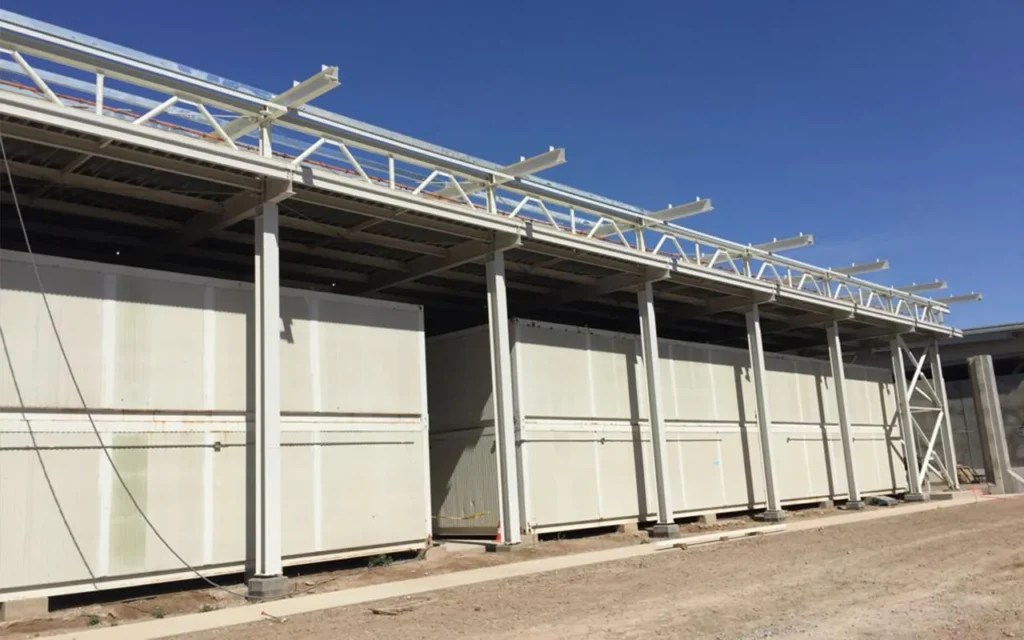
The Baghdad Diplomatic Support Center, situated at Sather Air Base in Iraq, necessitated enhanced protection for its accommodation facilities, prompting the implementation of an external overhead cover system. Our role involved crafting static projects for a pre-engineered steel structure, spanning 1,457.83 square meters, and standing at an eave height of 9.27 meters.
The steel frame provides structural support for overhead protection featuring two distinct layers that significantly enhance the system’s resistance to blast impact. Positioned above the shielding layer, the pre-detonation layer is constructed with structural insulated foam roof panels. The shielding layer, which consists of a metal deck supporting ballistic-resistant fiberglass layers, forms the lower portion of the protective structure. This dual-layer design ensures a robust defense mechanism, fortifying the US diplomatic support staff against potential threats with a comprehensive and effective protective solution.
The overhead cover system for containerized housing units (CHU’s) comprises primary elements such as columns and beams, and secondary elements including purlins, girts, and vertical and horizontal bracings. Since they are completely demountable, they can be assembled and disassembled multiple times. Galvanized bolts and nuts facilitate sturdy connections, and the design enables the replacement of damaged structural elements with ease. Conforming to codes, the architectural and structural design of the pre-engineered steel frame underwent rigorous analysis. Frames and posts fabricated from hot-rolled steel profiles based on structural calculations, boast a durable two-layer primer coating. Anchorage plates and bolts firmly secure columns to the ground, ensuring stability and reliability in the face of potential threats. The enhanced protective measures seen in the project proves the effectiveness and adaptability of pre-engineered solutions in challenging environments.